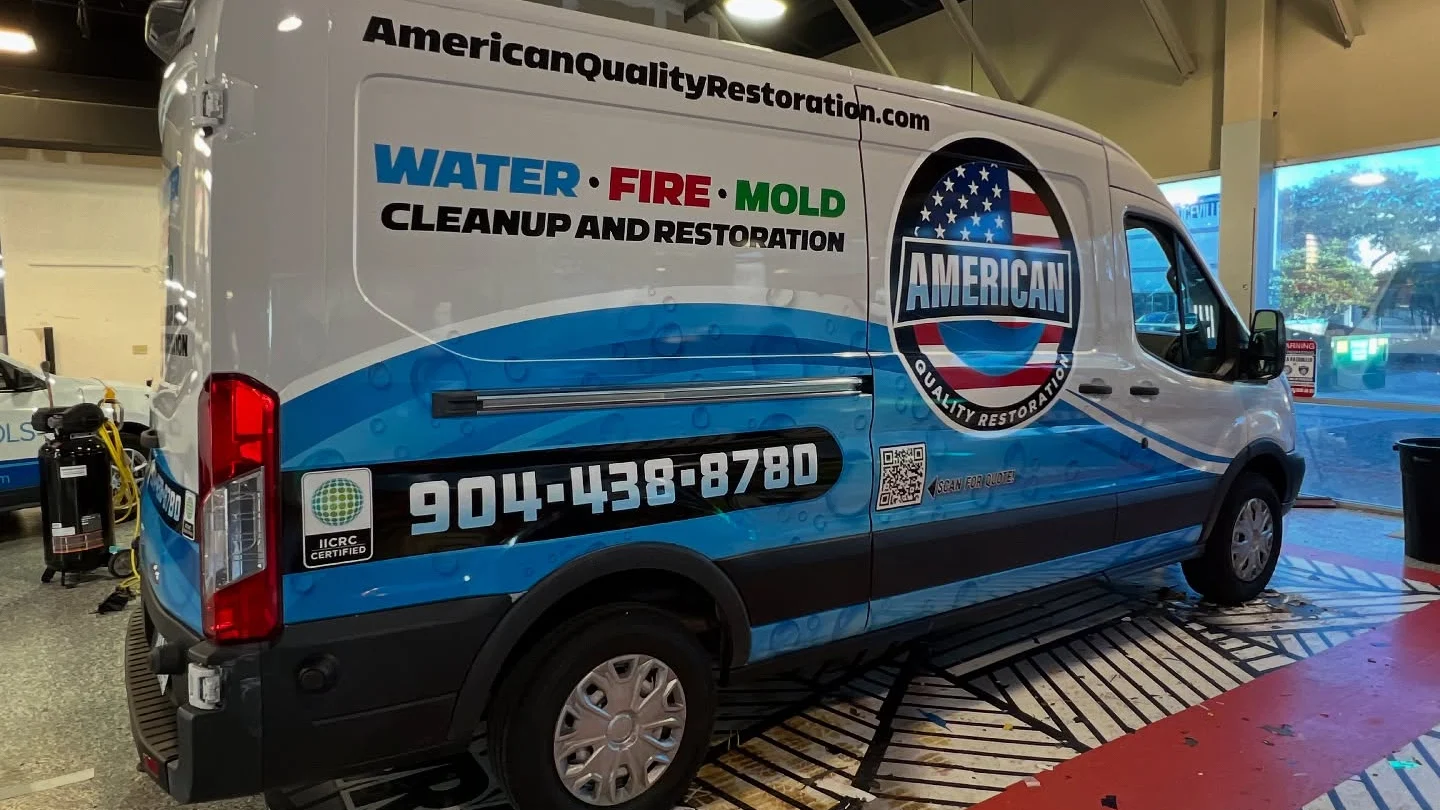
Large Loss and Catastrophic Response in Jacksonville
Large loss and catastrophic response in Jacksonville and surrounding areas. IICRC-certified technicians, insurance billing accepted. Call (904) 438-8780.
When a loss is too big for a single crew, too complex for a standard claim file, or spread across multiple buildings or floors, the response has to change shape entirely. A burst main flooding three floors of an office tower, a fire that takes out half a strip center, a named storm that damages a portfolio of rental properties at once: these losses need simultaneous mitigation across multiple zones, a general contractor’s eye for sequencing, and documentation detailed enough to survive a large loss adjuster’s review. American Quality Restoration’s technicians hold IICRC certifications in water, fire, mold, and structural drying, and the company carries license #MRSR4374 for the reconstruction work that typically follows a catastrophic event.
What Large Loss and Catastrophic Response actually involves
Large loss work is defined less by a dollar figure and more by scale and coordination: multiple affected structures or floors, several trades working at once, and a claim large enough that a dedicated adjuster or third-party administrator is assigned before mitigation even finishes. A single apartment water loss might need one crew and a handful of air movers. A catastrophic loss, by contrast, a flooded medical office building, a hurricane-damaged industrial warehouse, a fire that spreads through shared attic space in a multi-tenant strip center, needs crews staged in parallel, drying equipment deployed by the dozen, and a project manager tracking moisture logs, demolition scope, and contents inventory across every affected space at once. The work spans emergency mitigation (extraction, drying, board-up, tarping) through structural demolition and into reconstruction, often without a pause between phases because an occupied building or operating business is waiting on the other side.
Our process
- Rapid mobilization and crew scaling. Instead of sending one technician team, large loss response means pulling in multiple crews, additional drying equipment, and a dedicated project manager on day one so every affected zone gets attention simultaneously rather than sequentially.
- Full-scope documentation across every affected area. Moisture readings, photos, and damage notes are logged floor by floor or unit by unit, building a file detailed enough for a large loss adjuster to review line by line rather than taking a contractor’s word for it.
- Mitigation and demolition at scale. Extraction, structural drying per IICRC S500 guidelines, and controlled demolition happen in parallel across the structure, with drying equipment placement and air movement calculated per zone rather than applied uniformly.
- Direct coordination with adjusters and property managers. On a catastrophic claim, the insurance side typically involves a dedicated large loss adjuster or TPA; American Quality Restoration provides regular progress updates, moisture logs, and photo documentation so the claim moves without the back-and-forth that stalls smaller jobs.
- Phased reconstruction scope. Once mitigation clears, a written scope of work sequences framing, drywall, electrical, and finish work by zone, allowing partially restored sections of a building to come back online while work continues elsewhere.
What separates a good large loss response from a bad one
The biggest failure point on a catastrophic claim isn’t the drying, it’s the coordination. Undersized crews that try to handle a multi-floor loss the same way they’d handle a single room end up with drying equipment running for weeks longer than it should, and moisture that gets missed in one wing shows up as a mold problem in another a month later. Adjusters reviewing large claims are looking for granular documentation: moisture maps by room, not by building; photo timestamps that match the equipment logs; a demolition scope that matches what was actually wet, not what was convenient to remove. Operators without reconstruction capability also create a dangerous gap, handing a mitigated but gutted building back to the owner with no plan for putting it back together, which is why the mitigation and rebuild scope need to come from the same team working off the same file.
What does Large Loss and Catastrophic Response cost?
Catastrophic and large loss claims vary enormously depending on the number of structures involved, how many floors or units are affected, and whether reconstruction is included in the scope. Every loss is different, and American Quality Restoration provides a written scope of work before any mitigation or rebuild work begins so property owners and adjusters are working from the same numbers. Most commercial and large residential policies cover large loss mitigation and reconstruction up to policy limits, though business interruption and code upgrade coverage varies by policy and is worth confirming with the carrier early.
| Scenario | Typical range |
|---|---|
| Single large commercial space, mitigation only | $25,000 - $75,000 |
| Multi-unit residential building, water loss | $50,000 - $250,000 |
| Commercial building, fire and smoke damage | $100,000 - $500,000+ |
| Industrial facility, storm or flood damage | $250,000 - $1,000,000+ |
| Multi-building portfolio loss | $500,000 - $2,000,000+ |
Seasonal & regional considerations
Jacksonville’s hurricane season brings the highest concentration of catastrophic claims: storm surge and wind-driven rain can affect an entire apartment complex or business park in a single event, which is exactly the scenario large loss response is built for. Flat commercial roofs common across Northeast Florida industrial and retail buildings are also prone to ponding and large-scale leaks after extended rain, sometimes going undetected until ceiling tiles fail across an entire wing.
Service area
American Quality Restoration handles large loss and catastrophic response for commercial, multi-family, and industrial properties throughout Jacksonville, Jacksonville Beach, Orange Park, Ponte Vedra Beach, Atlantic Beach, Neptune Beach, Fleming Island, and Fruit Cove.
If you’re managing a loss that spans multiple units, floors, or buildings, call (904) 438-8780 to get a crew and project manager mobilized and a written scope started.
Frequently Asked Questions
Does homeowners or commercial insurance cover large loss and catastrophic response?
At what point does a loss get classified as "large loss" instead of a standard claim?
How many crews are deployed on a catastrophic restoration job?
What documentation does a large loss adjuster expect to see?
Can a damaged building stay partially occupied during a large loss restoration?
Looking for the best large loss and catastrophic response company in Jacksonville?
American Quality Restoration provides licensed and insured large loss and catastrophic response in Jacksonville, FL and the surrounding area, and has served local property owners since 2021. Customers rate us 5.0 out of 5 stars across 62 Google reviews. We answer calls 24/7 — call (904) 438-8780 for immediate help.
Need Large Loss and Catastrophic Response now?
We respond 24/7 across Jacksonville and surrounding FL cities.