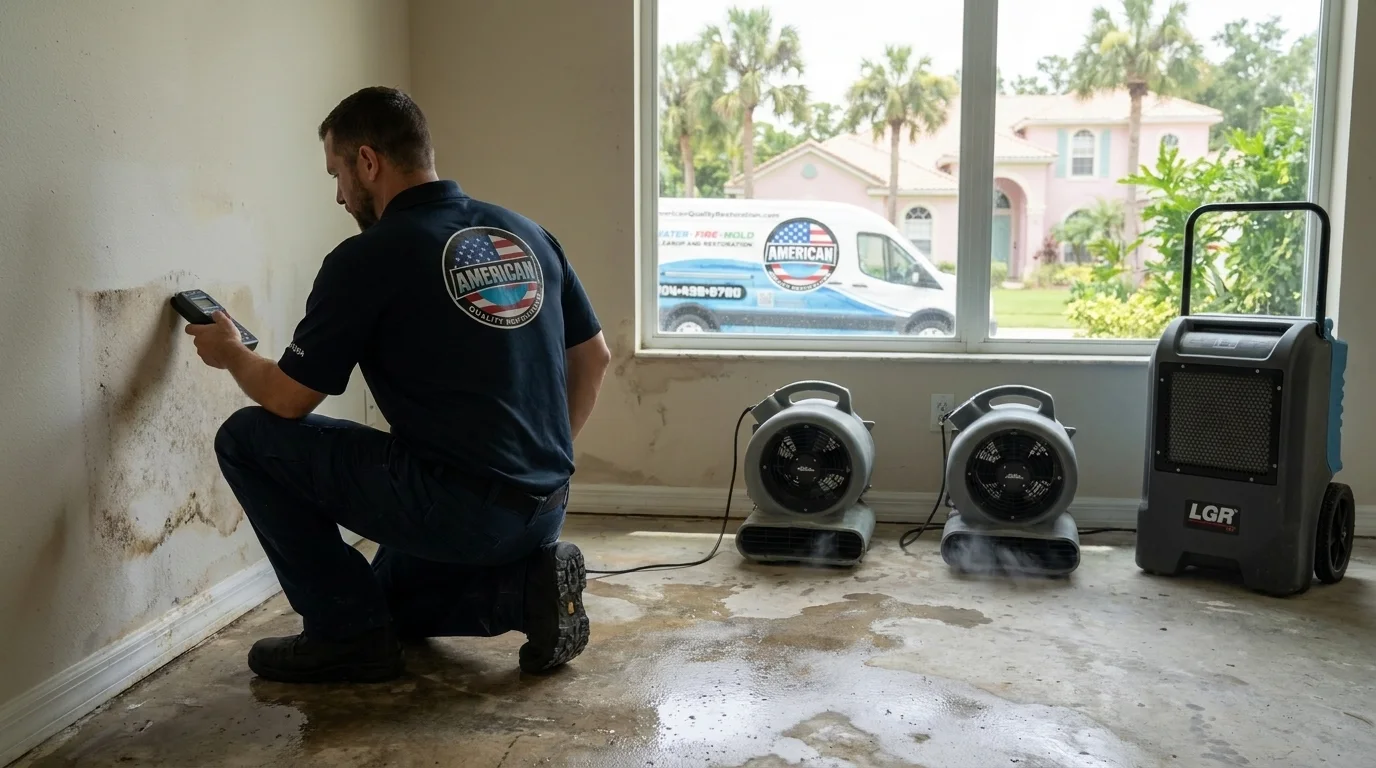
24/7 Emergency Water Damage Restoration in Jacksonville Beach
24/7 emergency water damage restoration in Jacksonville Beach, FL. IICRC-certified technicians, insurance billing accepted. Call (904) 438-8780.
Our IICRC-certified technicians are dispatched from our Jacksonville, FL headquarters and are typically on-site in Jacksonville Beach within 60 minutes of your call.
Water damage emergency in Jacksonville Beach? We answer 24/7. Call now and our crew heads out to stop the water and start drying your property.
Water damage in a beach town behaves differently than it does ten miles inland. Jacksonville Beach sits on a barrier island between the Atlantic and the Intracoastal Waterway, which means a burst supply line or a wind-driven rain event doesn’t just add moisture to drywall, it adds moisture to soil and foundations that are already saturated most of the year. Water removal and structural drying here have to account for that baseline humidity from the first hour on site, not just the leak itself.
Why Jacksonville Beach Properties See Water Damage Issues
A lot of the housing stock near the beach was built for airflow and salt air, not for sealing out water. Older block homes and raised cottages often have crawlspaces or low first floors that sit close to the water table, so a slab leak or washing machine overflow can wick sideways into framing before anyone notices a wet spot on the floor. Add in Florida’s summer thunderstorm pattern and the occasional tropical system pushing storm surge or heavy rain off the Atlantic, and you get a steady stream of calls for everything from a failed water heater to wind-driven rain intrusion around older window flashing. Galvanized and copper plumbing in beach-area homes also corrodes faster than it would further inland, thanks to salt in the air finding its way into attics and wall cavities.
Our Water Damage Restoration Process in Jacksonville Beach
The first visit is about finding where the water actually went, not just where it showed up. Technicians use moisture meters and thermal imaging to track water behind baseboards, under tile, and into subfloor, since coastal slab homes can trap moisture under flooring for weeks if it’s missed. Extraction comes next, pulling standing water out before it has a chance to migrate further into porous materials. Structural drying is set up according to the IICRC S500 standard, with air movers and dehumidifiers sized for Jacksonville Beach’s ambient humidity rather than a generic drying chart, because a dehumidifier that works fine in a dry inland climate often can’t keep up with beach-town moisture load on its own.
Jacksonville Beach Insurance & HOA Coordination
A fair number of Jacksonville Beach properties, especially condos and homes close to the dunes, carry separate flood coverage alongside a standard homeowners policy, and the two don’t always cover the same water event. Part of our job on site is documenting whether the water came from a plumbing failure, roof intrusion, or ground-level flooding, since that distinction often determines which policy responds. For condo and townhome communities with an HOA, we coordinate with property management on interior access and shared-wall drying schedules so the work doesn’t stall waiting on board sign-off.
Equipment & Methods We Use for Water Damage
Beyond extraction units and air movers, drying a beach-area property usually means running dehumidifiers longer and checking moisture content more often than an inland job would need. Technicians holding IICRC Water Damage Restoration (WRT) and Structural Drying (ASD) certifications use that extra monitoring to confirm materials have actually released their moisture, not just that the surface feels dry to the touch, which matters in a climate where humidity can re-saturate a wall cavity overnight if drying stops too early.
Local note
Many Jacksonville Beach homes near the Intracoastal side of the island sit on lower ground than properties closer to the dunes, so after a heavy rain event it’s common to see water intrusion at the slab edge on one side of a block while the other side stays dry. Crews working this area check grading and drainage patterns around the foundation as part of the initial assessment, since where the water came from often predicts where it’s still hiding.
If water is spreading through your Jacksonville Beach home or business right now, every hour it sits in flooring and framing adds to the drying time and the cost. American Quality Restoration answers 24/7 and sends IICRC-certified technicians to assess the damage, start extraction, and get structural drying underway before moisture has a chance to settle into this island’s already humid building materials.
Serving Jacksonville Beach from our Jacksonville headquarters — ★ 5.0 · 62 Google reviews
“Marshall came out to my house and took a look at an outside wall. My concern was to make sure there was no mold or mildew inside the wall. Marshall didn’t try to talk me in to any unnecessary repairs. Even though he had nothing to gain, he was kind enough to give me advice on what I should do to…” — Joseph, February 2026Read our reviews on Google →
Water Damage Restoration in Jacksonville Beach: Service Coverage
Frequently Asked Questions
How fast can you arrive for water damage restoration in Jacksonville Beach?
How does Jacksonville Beach's high water table affect water damage restoration?
Do Jacksonville Beach condos need different water damage handling than single-family homes?
Are older Jacksonville Beach homes more prone to hidden water damage?
What's the difference between flood water and plumbing-leak water damage for insurance purposes in Jacksonville Beach?
How long does structural drying take for a Jacksonville Beach property?
Water Damage Restoration response in Jacksonville Beach
Most Jacksonville Beach calls see a technician on-site within 60 minutes from our Jacksonville headquarters.
Nearby & Related
- 24/7 Emergency Water Damage Restoration in Jacksonville
- Restoration Services in Jacksonville Beach
- Mold Remediation in Jacksonville Beach
- 24/7 Emergency Sewage Cleanup and Sanitization in Jacksonville Beach
- 24/7 Emergency Water Damage Restoration in Atlantic Beach
- 24/7 Emergency Water Damage Restoration in Fleming Island
- Contact American Quality Restoration